- Our Location:
- Cambodia, Brazil, Morooco, Saudi Arabia, Hong Kong, Thailand


Brazil is one of the world’s largest sugar exporters, supplying refined and raw sugar to wholesalers, distributors, food manufacturers, beverage companies, and industrial buyers worldwide.
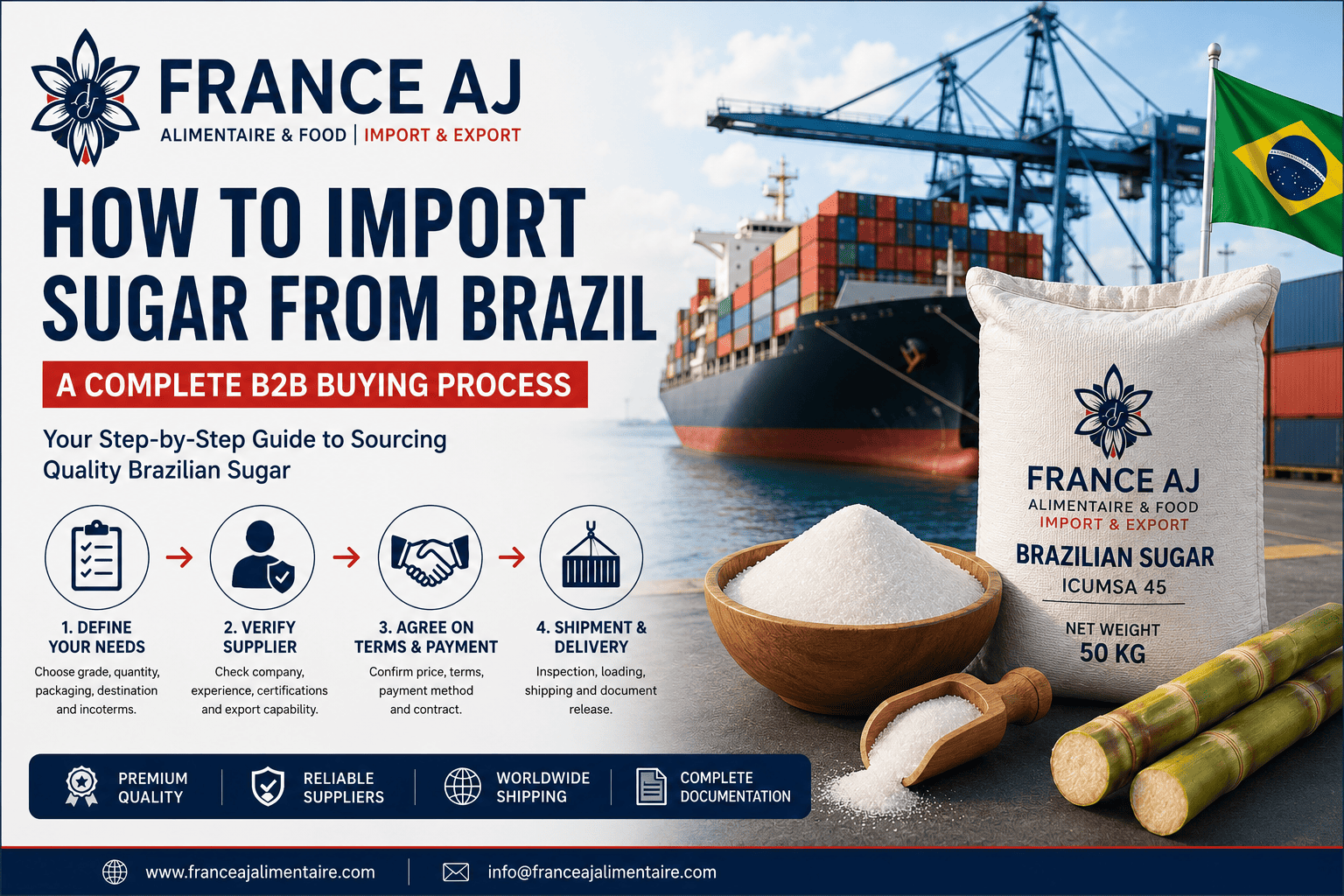
Importing Brazilian sugar requires more than finding a competitive price. Buyers must select the correct sugar grade, verify the supplier, understand shipping terms, and prepare the required documents.
In this guide, France AJ Alimentaire explains the essential steps for importing Brazilian sugar safely and efficiently.
Brazil offers large production capacity, modern sugar mills, competitive export prices, flexible packaging, and reliable international logistics. Brazilian sugar is suitable for food production, beverages, confectionery, retail packaging, refining, and industrial processing.
ICUMSA 45 is highly refined white sugar commonly used in beverages, food manufacturing, pharmaceuticals, and retail products.
ICUMSA 150 is suitable for general food processing and industrial use, while VHP and raw sugar are mainly purchased by refineries and large industrial buyers.
Learn more in our ICUMSA Sugar Grades Explained guide.
Before placing an order, buyers should verify the supplier’s company registration, export experience, product specifications, certificates, commercial documents, and inspection options.
Avoid offers with unrealistic prices, incomplete company information, unclear payment conditions, or pressure to transfer funds quickly.
A professional quotation request should include:
• Required sugar grade
• Quantity in metric tons
• Packaging type
• Destination port
• Preferred Incoterm
• Shipment schedule
Providing complete information helps the supplier prepare accurate product and shipping costs.
FOB means the supplier loads the sugar onto the vessel, while the buyer arranges ocean freight and insurance.
CFR includes ocean freight to the destination port, but the buyer arranges insurance.
CIF includes ocean freight and marine insurance, making it a convenient option for buyers who want the supplier to manage the main shipping process.
Common export documents include the Commercial Invoice, Packing List, Bill of Lading, Certificate of Origin, and Certificate of Analysis.
Depending on the destination, buyers may also require Halal certification, SGS inspection, phytosanitary documents, insurance certificates, or other regulatory documents.
Independent inspection can verify product quality, weight, packaging, container condition, and loading before shipment.
Common mistakes include choosing a supplier only because of a low price, ordering the wrong ICUMSA grade, failing to verify banking information, ignoring inspection options, and not confirming import requirements.
France AJ Alimentaire supports international buyers sourcing Brazilian sugar for wholesale distribution, food manufacturing, beverage production, and industrial use.
Our team assists with product selection, quotations, export documentation, quality inspection, packaging, and international shipping arrangements.
To receive a customized offer, please provide your required sugar grade, quantity, packaging, destination port, preferred Incoterm, and shipment schedule.
Contact France AJ Alimentaire today to discuss your Brazilian sugar requirements.
Discover our refined white sugar, ICUMSA grades, wholesale packaging, and international B2B shipping solutions. Visit our Salt and Sugar product category to view available products and request a quotation.